
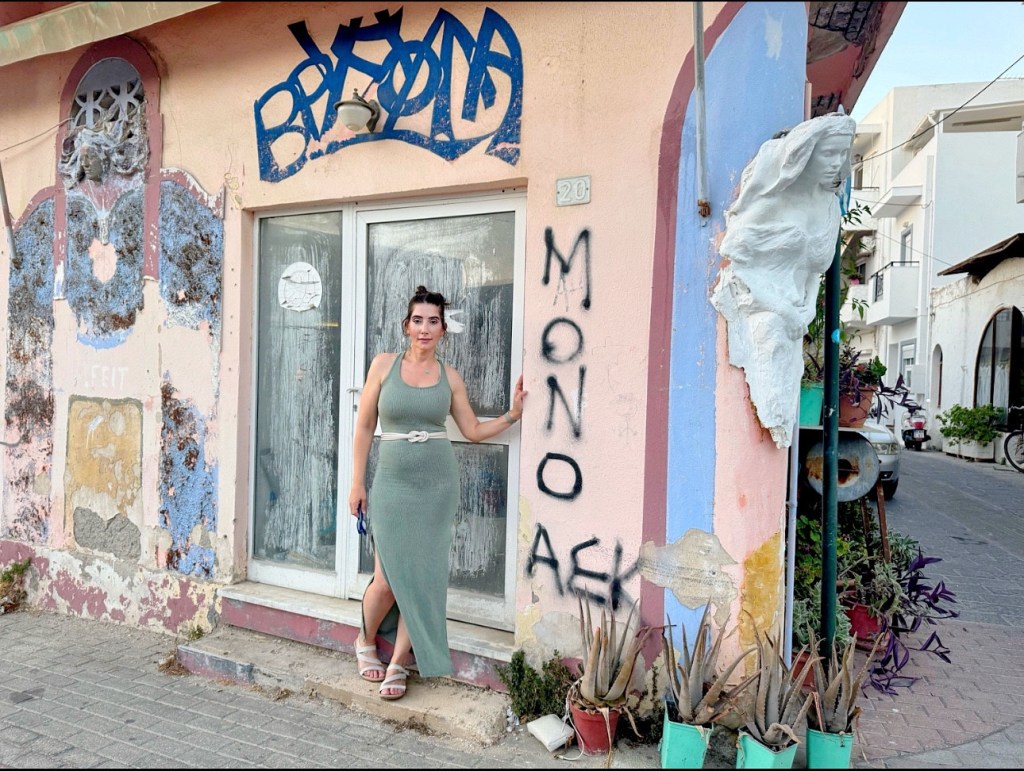
The last time I traveled to the beautiful tourist island of Kos, Greece—where my father was born and raised—was 35 years ago. I was a young teenager then, and while much of that experience has faded from memory, I do remember loving it. I felt a sense of wonder exploring a place so different from where I lived in New York.
My father left Greece at the age of 22, and he never returned. That made this recent trip of mine to Kos, in July of 2025, especially meaningful. As an adult, I carry different questions about this place than I did when I was 14. I went hoping to understand more about where he came from, but also more about where I came from. Instead, I returned with even more questions and very few answers.
Still, I don’t need to ask why he left. From 1955 to 1970, approximately one million Greek immigrants left to live in other countries and for the same reasons: to seek opportunity, stability, and a better life for their families. They were drawn by the promise of financial security, strong education systems, and stable futures for their children. But life offers no guarantees. Some immigrants found success. Others, like my father—who became a victim of crime in the U.S.—faced unexpected hardships, passing at the young age of 57. It makes me wonder: would staying in Greece have been the better choice for him?
Now at 49, I find myself questioning everything—my identity, my roots, and how my life might have also been different under other circumstances.
While in Kos, I met a Greek boat captain who told me he was born in Ohio, to Greek parents. However, his parents brought him back to Greece when he was 10, and he’s lived there ever since. He shared that they regretted their decision to return—and from the look in his eyes, I think he might have, too. I saw a man quietly wondering what could have been. Would he still be captaining a boat full of noisy tourists in the hot sun, or might he have become a doctor or lawyer in the U.S.? And even if his life had been different, would he still carry the same questions I do?
I didn’t ask him. Just as I never asked my father.
But I was able to ask my mother, who is still alive and living in Port Jefferson, NY. She left Greece when she was just 17 years old. When I asked her why she left, she explained that there were no jobs available in Greece at the time—it was 1969—and her family was poor.
“My father was just a farmer and he couldn’t afford to send me to college and he also didn’t have money to give me a dowry,” she said. “Back then, to get married, girls had to have a dowry—or maybe a house, or some kind of property.”
My mother’s family led a very simple life in a small village called Πράσινο (Prasino, which means “Green”), located about an hour by car from the nearest city, Tripoli. According to Wikipedia, Πράσινο is situated on a mountain slope at an elevation of 820 meters. It was noted that in 1981, only 500 inhabitants remained in the village—and by 2021, that number had dropped to just 104. For younger generations, it was clear that Prasino could not offer a fulfilling future due to its dwindling population and lack of opportunity.
Before leaving Greece, my mother was sent to Athens at just 15 years old to work as a nanny for a family with 2 children. All the money she earned was sent back to support her parents and siblings in her village. She wasn’t able to attend high school, and college was completely out of reach. So, she left Greece with the hope of getting an education and finding a good job.
She first went to Canada, where she had some relatives and stayed with them. But, ultimately, she decided to leave and head to the United States because she found the Canadian climate too cold and didn’t like it.
Around the same time, my father had gone to Australia. But like my mother, he didn’t like it there and eventually left for the United States. I’m not entirely sure what his reasons were, but my mother believes it was because he missed his family—his mother and sisters had already moved to the U.S.
It was in Jamaica, Queens, New York, where my parents eventually started dating. My mother was close friends with his sister Katina, who encouraged the two of them to get together. They eventually married and started a family, and where my brother and I would later grow up in Astoria, Queens.
When I asked my mother how she felt about coming to a new country—and whether she was scared—she said she wasn’t scared, but instead excited. She did feel a little anxious because she didn’t speak any English, but she learned quickly. I asked if, looking back now, she was happy with her decision to come to the United States, and she said, “I wouldn’t have it any other way!”
What I still can’t understand is why my father never returned to visit this magical island of Kos, Greece, that so many tourists escape to, from all parts of the world. Not even once. At one point, he had the chance to help build a hotel there, but the opportunity fell through. Still, what about before then? Was he trying to leave the past behind? Were there memories he didn’t want to face? I’ll never know. And I wish I had asked him when I had the chance.
I hoped my mother could help me and so I asked her if she thought my father was happy with his decision to come to the U.S. and leave Greece, and, she emphatically said, “Yes, he definitely was!” That brought me some comfort, and I believed deep down, that that is what he really felt.
Now, as an adult searching for meaning in my own life, I find myself looking backward for answers for myself—answers that may lie in the past but are no longer accessible and maybe perhaps even, no longer relevant. I am realizing that it doesn’t matter so much where you live as long as you are at peace with yourself. You can live in the richest of countries with all the opportunities in the world, but if you do not possess wealth in your heart, no amount of riches will make you feel wealthy enough.
Philosophers like Eckhart Tolle teach that the past and future don’t truly exist, and that our focus should remain on the present moment.
But I wonder: when your past is filled with untold stories, unresolved questions, and connections you never fully understood—how do you stay fully in the present?
 Chrysa Kalimera
Leave a comment